.
Home » Bakuchiol and Vitamin C: Why This Skin-Brightening Duo Only Works When You Get the Formula Right

But here’s what often gets overlooked: not all vitamin C is created equal. And if you’re using the wrong type, you could be undermining everything this combination is capable of — particularly if you have difficult, sensitive skin.
Here’s what the science actually says — and how to make it work for your skin.
Before we get into formulation, it’s worth understanding why this combination generates so much excitement.
Bakuchiol is a plant-derived ingredient that has earned serious scientific credibility as a gentler alternative to retinol. Extracted from the seeds of the Psoralea corylifolia plant, it activates the same retinol receptors in the skin — stimulating collagen production, improving skin texture, and visibly reducing the appearance of fine lines — without the peeling, redness, or sun sensitivity that retinol often brings.
Vitamin C, meanwhile, is one of the most well-researched brightening and antioxidant ingredients in skincare. It helps neutralise free radicals (the unstable molecules that accelerate skin ageing), supports collagen synthesis, and works to fade uneven pigmentation over time.
Together, they take a two-pronged approach to skin ageing:
– Bakuchiol works on structure — improving firmness, smoothing texture, and encouraging the skin to renew itself
– Vitamin C works on tone — brightening dullness, protecting against environmental damage, and supporting the collagen bakuchiol helps build
The synergy is real. But the results depend entirely on which form of vitamin C you’re actually using.
The vitamin C most commonly found in skincare is L-ascorbic acid — the pure, active form. It’s effective, yes. But it comes with a significant catch that doesn’t get nearly enough attention.
To penetrate the skin’s surface and become active, L-ascorbic acid requires a highly acidic pH — typically between 2.5 and 3.5. That’s considerably more acidic than your skin’s natural environment, which sits at around pH 5.5.
Think of your skin’s acid mantle as a finely tuned security system. It keeps moisture in, environmental aggressors out, and your skin microbiome balanced. Repeatedly applying something at pH 3.0 can disrupt that system — leading to redness, sensitivity, and increased transepidermal water loss (TEWL), which is simply the term for moisture escaping through the skin barrier.
1. The barrier disruption problem — A formula at pH 3.0 isn’t just slightly off from your skin’s natural pH 5.5; with repeated use, it can compromise barrier integrity
2. The instability problem — L-ascorbic acid oxidises when exposed to light and air, turning orange or brown. Oxidised vitamin C doesn’t just lose effectiveness; research suggests it can actually generate free radicals rather than neutralise them
3. The sensitivity problem — For anyone with reactive skin, rosacea, or a compromised barrier, the “sting” that traditional vitamin C delivers can trigger micro-inflammation — and chronic low-grade inflammation is one of the key drivers of accelerated skin ageing
This is where formulation intelligence makes all the difference.
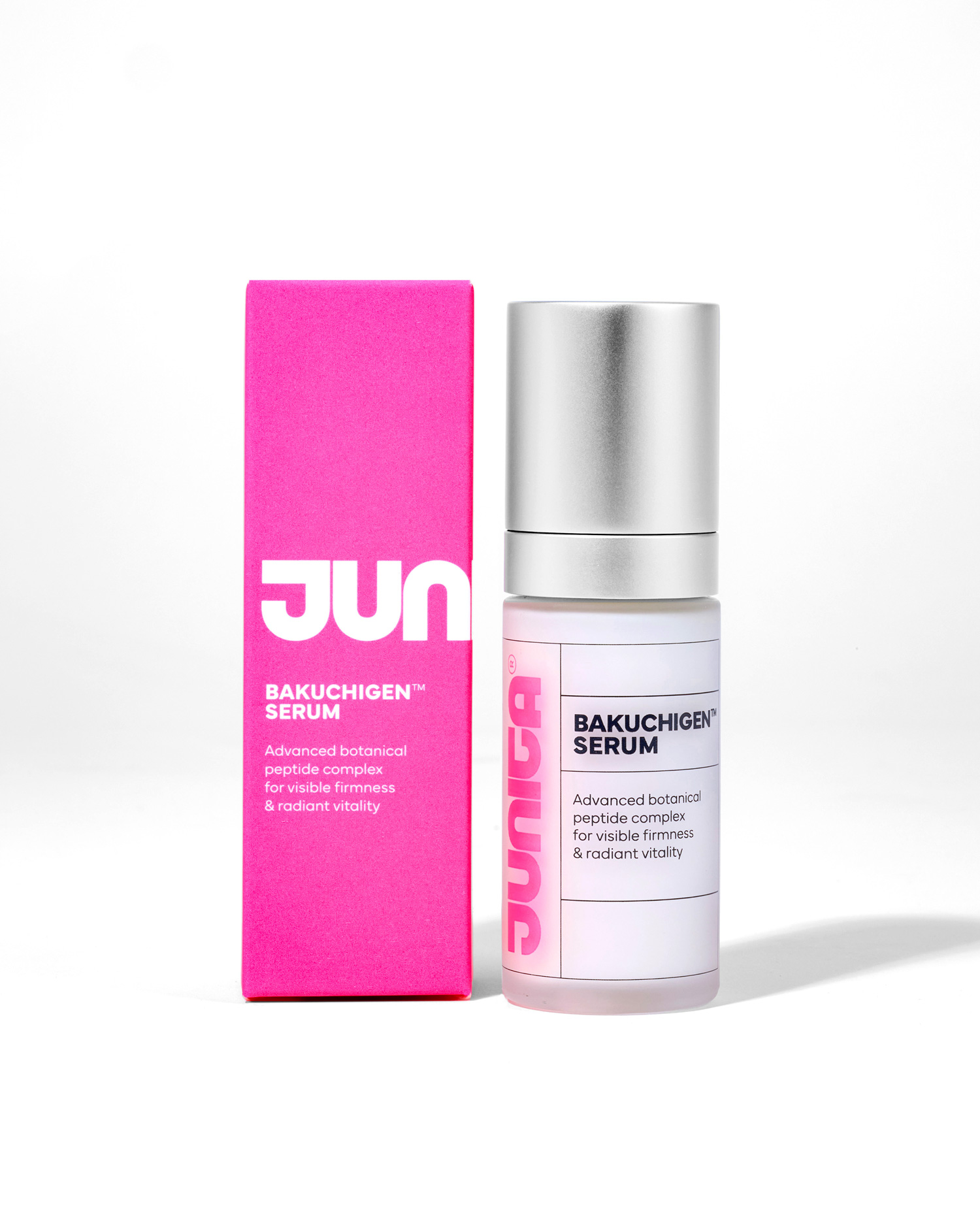
Rather than working with L-ascorbic acid, Junita’s Bakuchigen Serum uses a sophisticated vitamin C derivative called Ascorbyl Tetraisopalmitate — a lipid-soluble form of vitamin C that sidesteps all three problems above.
It’s oil-loving, not water-loving
Standard L-ascorbic acid is water-soluble, which means it sits at the skin’s surface waiting to be absorbed. Ascorbyl Tetraisopalmitate is lipid-soluble — it integrates naturally with your skin’s own oils and penetrates more efficiently into the deeper layers where collagen production actually happens.
It works at a skin-friendly pH
Because it doesn’t need an acidic environment to become active, it can be formulated at pH 5.5 — in harmony with your skin’s natural chemistry. No sting. No disruption. No compromise.
It stays stable
Ascorbyl Tetraisopalmitate is significantly more resistant to oxidation than L-ascorbic acid. It maintains its potency when exposed to light and air, which means the vitamin C in your serum is actually doing its job — not quietly degrading in the bottle.
When these two ingredients are formulated together correctly, something genuinely interesting happens.
Bakuchiol signals the skin to produce new collagen — specifically Type I and Type III collagen, the structural proteins responsible for firmness and elasticity. Vitamin C in its stable, lipid-soluble form then supports that process by acting as a co-factor in collagen synthesis, helping to stabilise and reinforce the collagen fibres that bakuchiol encourages the skin to produce.
At the same time, both ingredients offer antioxidant activity — meaning they work together to neutralise the free radicals that would otherwise break down that collagen. The result is a more complete, sustained approach to skin renewal.
Research into bakuchiol and stable vitamin C derivatives indicates that the combination improves skin elasticity and reduces the appearance of hyperpigmentation more effectively than either ingredient used alone.

It’s also worth noting: the Bakuchigen Serum is pregnancy-safe. For those navigating skincare during pregnancy who miss retinol, this offers a clinically-informed alternative that doesn’t require compromise.
A well-designed formula is never just about one or two ingredients. The Bakuchigen Serum brings together a considered combination of actives that each play a distinct supporting role:
– Ferulic Acid (2%) — Enhances the stability and effectiveness of antioxidants including vitamin C, whilst providing additional free radical protection in its own right
– Rose Damascena Flower Water — Soothes and calms reactive skin, helping to balance pH and provide gentle hydration
– Hyaluronic Acid — Draws moisture into the skin and helps plump the appearance of fine lines
– Rosehip Seed Oil — Rich in essential fatty acids that nourish and support skin texture
– Peptides — Support the skin’s natural collagen synthesis for improved firmness and resilience over time
Together, these ingredients create a complete anti-ageing environment — not a single active doing all the heavy lifting, but a team working in concert.
Getting the most from your serum starts before you even open the bottle. The condition of your skin when you apply an active serum dramatically affects how well it absorbs.
The ACB Hydrobalance Toner is the ideal first step. It contains the ACB Fruit Mix — a blend of natural glycolic and lactic acids derived from sources like bilberry and sugar cane — which gently exfoliates the surface layer of dead skin cells that can act as a barrier to serum absorption.
Crucially, it also contains niacinamide and is formulated to maintain your skin’s optimal pH. Think of it as clearing the path so that the actives in your serum can reach the skin layers where they’re most effective. Apply after cleansing, pat gently, and allow 30 seconds for absorption before moving on.
The Bakuchigen Serum is a light cream, housed in an airless pump bottle that protects the formula’s integrity from the moment you first use it. In the evening, dispense one to two pea-sized amounts onto your fingertips.
Rather than rubbing or pressing with your palms, use a gentle tapping motion — almost like a light “tap dance” across the face with your fingertips. This directs every bit of product exactly where it needs to go, with no cream lost to your palms or wasted by dragging. Tapping also encourages better absorption, as it helps the formula work into the skin rather than sitting on the surface.
Evening application makes particular sense here: your skin’s natural repair cycle peaks overnight, giving the actives the time and conditions they need to work most effectively.
In the morning, follow your routine with an SPF — non-negotiable when using any actives. If you’re looking for a daytime moisturiser that complements this approach, the Tetrapeptic Day Cream contains its own stabilised Vitamin C (Ascorbyl Tetraisopalmitate) alongside Tetrapeptide-21 for collagen support, making it a natural morning counterpart to your evening serum.
One of the most important things about this formulation is who it includes rather than excludes. Because it avoids the pH extremes of traditional vitamin C and the irritation potential of retinol, it’s genuinely suitable for:
– Sensitive skin — the lipid-soluble vitamin C and botanical ingredients work with the skin, not against it
– Those who’ve struggled with retinol — bakuchiol delivers comparable results without the adjustment period
– Pregnancy and breastfeeding — bakuchiol is widely regarded as a pregnancy-safe alternative to retinol (always check with your GP or midwife if you have specific concerns)
– Beginners to actives — no harsh introduction, no “purge” phase to navigate
– Experienced skincare users — the ferulic acid, peptide complex, and stabilised vitamin C offer genuine potency for those who want results, not just comfort
Patience is part of any effective skincare routine. Here’s a realistic timeline:
– Weeks 1–2: Skin may feel more hydrated and appear slightly more radiant as the hyaluronic acid and botanical hydrators get to work
– Weeks 3–4: Surface texture tends to improve and skin tone may begin to appear more even
– Weeks 6–8: More visible changes in firmness and the appearance of fine lines as collagen support builds
The most significant improvements in skin tone, texture, and elasticity typically become visible after three months of consistent use
These are not overnight fixes. They’re ingredients that work with your skin’s biology — and that takes time to show up on the surface. Be patient. It’s worth it.
No serum works in isolation. A few simple habits make a meaningful difference to how your skin responds to active ingredients:
– Antioxidant-rich foods — berries, leafy greens, and colourful vegetables support your skin’s internal defence system
– Consistent hydration— well-hydrated cells respond better to topical actives
– Sleep — your skin’s repair processes peak overnight, which is precisely why evening application of the Bakuchigen Serum aligns with your skin’s natural rhythm
Bakuchiol and vitamin C is one of the most genuinely exciting combinations in modern skincare — but only when the formulation is built around the right version of vitamin C. By choosing a lipid-soluble, pH-neutral form like Ascorbyl Tetraisopalmitate, you get all the brightening and collagen-supporting benefits without the barrier disruption, instability, or sensitivity that traditional L-ascorbic acid can bring. That’s not a small detail. That’s the difference between a formula that works for most skin and one that works for yours.
References:
Chaudhuri & Bojanowski, 2014 — Bakuchiol and skin repair
Pullar, Carr & Vissers, 2017 — Roles of vitamin C in skin health
Telang, 2013 — Vitamin C in dermatology
Subscribe now to keep reading and get access to the full archive.